
 Tap to zoom
Is Every Testicular Lump a Sign of Cancer?
Not every testicular lump is cancer, but any new lump should be checked by a urologist. Learn common benign causes and warning signs.
- نویسنده
- دکتر مهدی قاضی
- Published on
- March 17, 2026
- Reading time
- 2 min read
- Last updated
- Updated: June 26, 2026
No, not every lump you feel in the testicle means cancer. Many testicular lumps are benign and do not threaten a person’s health. However, some lumps can be a sign of testicular cancer, which is why evaluation by a urologist is essential. Timely diagnosis and treatment in these cases can be vital.
Testicular lumps can develop for different reasons. The most common include:
Epididymal cyst (Epididymis): a fluid-filled sac that forms in the tube behind the testicle, the epididymis. These cysts are completely harmless and usually feel soft and movable when touched.
Varicocele (Varicocele): swelling of the veins inside the scrotum, which can feel like a “bag of worms” and is usually seen on the left side.
Hydrocele (Hydrocele): fluid buildup around the testicle that causes swelling and enlargement. In most cases, this condition is harmless and painless.
Inflammation or infection (epididymitis or Epididymitis and orchitis or Orchitis): infection of the tube behind the testicle (epididymis) or of the testicle itself, usually accompanied by pain, redness, swelling, and sometimes fever.
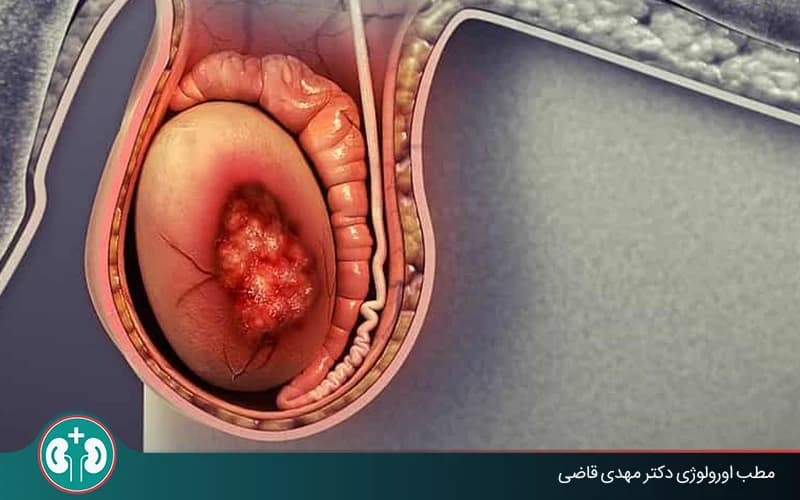
Testicular cancer: Testicular cancer usually appears as a hard, unusual, and often painless lump involving part or all of the testicle. It may sometimes be accompanied by a feeling of heaviness or mild pain.
Determining whether a lump inside the testicle is cancer requires several evaluations. The initial standard assessment includes physical examination and scrotal ultrasound, preferably Doppler ultrasound. If testicular cancer is suspected, further tests are also needed for a final diagnosis, such as blood tests for tumor markers (AFP, β-hCG, LDH) and pathology.
With timely diagnosis and treatment, testicular cancer has one of the highest successful treatment rates among all cancers; therefore, never delay seeing a doctor for evaluation of any change in your testicles.
Actions & related links
Doctors for this topic in Mashhad
See all doctors: Best Varicocele Doctors & Surgeons in Mashhad




About the author

Urologic Surgeon
دکتر مهدی قاضی, Urologic Surgeon in Mashhad. Articles on this site are written and reviewed under the supervision of the Urology Building's physicians.
View profile & bookRelated articles
All articlesBenign Urethral Lesions in Adults
دکتر مهدی قاضی · June 26, 2026
What Is Pyelonephritis? Kidney Infection Symptoms, Diagnosis, and Treatment
دکتر مهدی قاضی · March 20, 2026
Kidney Atrophy: Can a Small Kidney Be Dangerous?
دکتر مهدی قاضی · March 20, 2026
What Is Polycystic Kidney Disease? (Fetal and Adult PKD)
دکتر مهدی قاضی · March 20, 2026
Comments
0 comments
No comments yet. Be the first to share your thoughts.