 Tap to zoom
How Does a Ureteral Kidney Stone Pass?
Small ureteral stones under 5 millimeters often pass with urine over days to weeks, but severe pain, fever, vomiting, or reduced urine flow needs urgent urology care.
- نویسنده
- دکتر مهدی قاضی
- Published on
- March 8, 2026
- Reading time
- 2 min read
- Last updated
- Updated: June 26, 2026
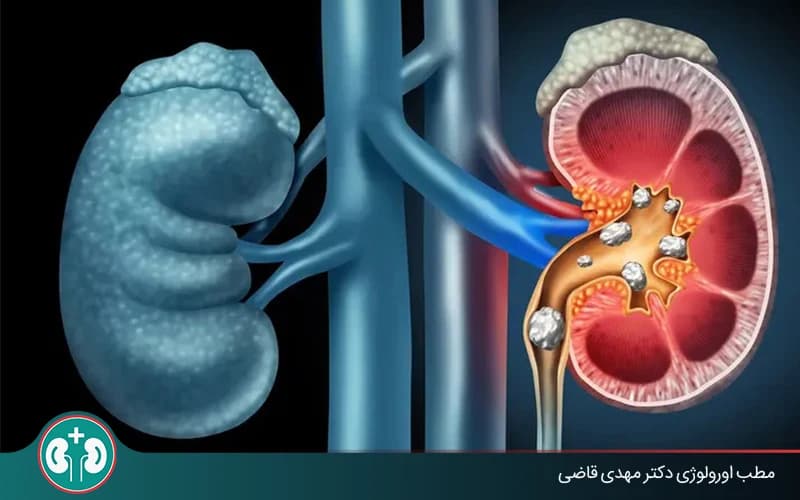
If a kidney stone becomes stuck in the ureter, the tube that carries urine from the kidney to the bladder, whether it passes depends on several factors, including the stone's size and location and the person's overall condition:
“Stones with a diameter of less than 5 millimeters often pass with the urine stream within a few days to a few weeks.” The larger the stone is, or the higher it is lodged in the ureter, the lower the chance of spontaneous passage. Keep reading as we explain in more detail how a kidney stone passes through the ureter.
Kidney and ureteral stone treatment: ESWL, laser and PCNL Kidney stone lithotripsy in Mashhad
Note: To improve care quality and patient satisfaction, appointments are triaged by reason for visit. Each physician sees patients within the relevant urology subspecialty.
Book appointment
Natural passage of a ureteral stone is a complex process that happens through urine flow, automatic contractions of the ureter, and sometimes with the help of medication:
The ureter works like a pump and, through wave-like contractions called peristalsis (Peristalsis), gradually pushes the stone downward toward the bladder.
Increasing fluid intake raises urine volume and increases the pressure applied to the stone, which can help it move.
In some cases, a urologist prescribes medications to relax the muscles of the ureter, such as tamsulosin (Tamsulosin), so the stone can pass more easily.
Passing a stone may be accompanied by severe pain in the flank and groin and “the time it takes to pass is different for each person.”
If the ureteral stone is large or causes complete blockage of the urine pathway with severe, persistent pain, spontaneous passage is unlikely. In this situation, the doctor may recommend other treatments such as extracorporeal shock wave lithotripsy (ESWL) or intracorporeal surgery/lithotripsy (TUL) . In these methods, the stone is broken into pieces or removed completely using specialized instruments.
Appointments related to Kidney and ureteral stone treatment: ESWL, laser and PCNL Kidney stone lithotripsy in Mashhad
Public recorded-slot data is available for this destination.
Book appointment
Therefore, if you experience severe and persistent pain, or symptoms such as fever and chills, nausea and vomiting, or a severe decrease or complete stop in urine flow, see a urologist immediately, because you may have urinary obstruction or an infection.
Q&A — Kidney and ureteral stone treatment: ESWL, laser and PCNL Kidney stone lithotripsy in Mashhad
General questions are shown on the destination page after review.
Book appointment
Actions & related links
Doctors for this topic in Mashhad
See all doctors: Lithotripsy and urinary stone treatment specialists in Mashhad




About the author

Urologist
دکتر مهدی قاضی, Urologist in Mashhad. Articles on this site are written and reviewed under the supervision of the Urology Building's physicians.
View profile & bookRelated articles
All articlesBenign Urethral Lesions in Adults
دکتر مهدی قاضی · June 26, 2026
What Is Pyelonephritis? Kidney Infection Symptoms, Diagnosis, and Treatment
دکتر مهدی قاضی · March 20, 2026
Kidney Atrophy: Can a Small Kidney Be Dangerous?
دکتر مهدی قاضی · March 20, 2026
What Is Polycystic Kidney Disease? (Fetal and Adult PKD)
دکتر مهدی قاضی · March 20, 2026
Comments
0 comments
No comments yet. Be the first to share your thoughts.